
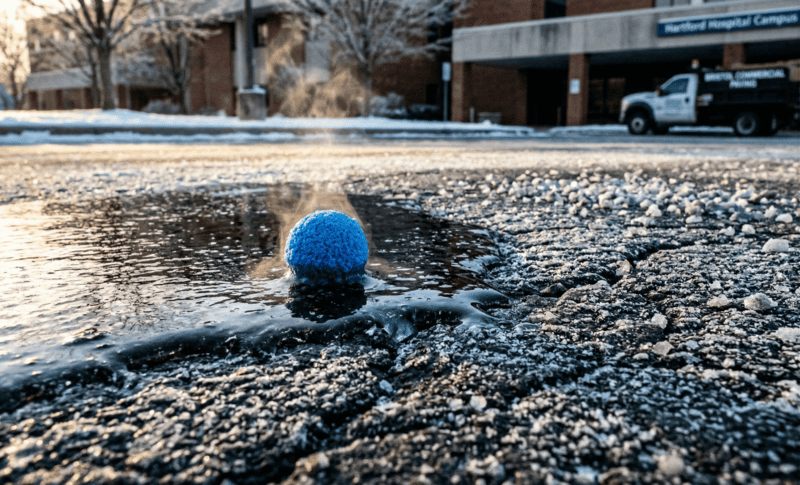
By the second week of February, Central Connecticut usually hits a brutal cycle: daytime thaws followed by sub-zero “flash freezes” at night. If you are still relying on standard sodium chloride (rock salt), you are leaving your property—and your bottom line—vulnerable.
The Technical “Eutectic” Reality Most commercial property managers in Hartford and Waterbury don’t realize that standard rock salt effectively stops working once the pavement hits 15°F. In the 2026 February “Deep Freeze,” that’s a recipe for black ice and a massive slip-and-fall liability.
-
The Problem: Rock salt is endothermic; it needs to draw heat from the environment to create a brine. When the sun goes down in Bristol this week, there is no heat to draw.
-
The KDM Solution: Our Industrial Blue and IB Granular products are engineered with a high-performance coating that remains active down to -20°F. By creating an exothermic reaction (releasing heat), we prevent the “bonding” of ice to the asphalt before the refreeze even begins.
Local Insight: Protecting the Farmington Valley Infrastructure We’ve seen an uptick in concrete spalling across Farmington and Avon due to low-grade melts that cause excessive freeze-thaw cycles. In 2026, the cost of repairing a commercial sidewalk has outpaced the cost of premium ice melt by 400%. Don’t trade a cheap bag of salt for a $20,000 masonry bill.


