
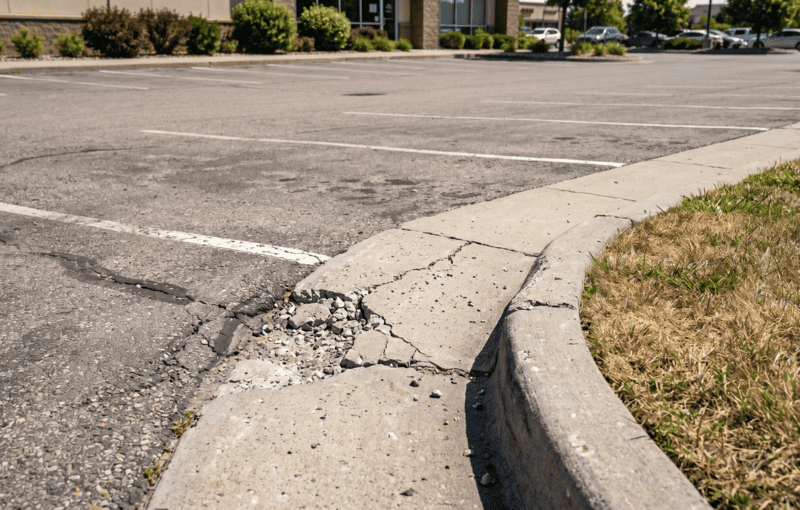
The snow is long gone. The parking lot looks fine from the car. The walkways are dry, the dumpster enclosure doors are swinging open and shut, and nobody’s calling about slip-and-fall incidents anymore.
But if you manage a commercial property anywhere from Hartford County to the Hudson Valley, and you haven’t done a serious post-winter surface assessment yet, you’re looking at last winter’s damage through a windshield — and missing most of it.
June is the month when the full picture becomes visible. The freeze-thaw cycles are done. The spring rains have flushed the surface residue. What’s left — the spalling concrete edges, the hairline cracks that weren’t there in October, the brown turf margins along the walks, the aggregate that’s working its way loose from the asphalt — that’s the bill for last winter’s deicing program. And it’s sitting right there, waiting to get worse before next November.
Here’s how to read that damage correctly, and what it should change about how you specify deicers for the 2026-2027 season.
What You’re Actually Looking At on a Post-Season Walkthrough
Most facilities managers do a spring walkthrough focused on general maintenance: potholes, line striping, lighting, landscaping. That’s the right instinct. But if you’re not specifically auditing deicing damage as its own category, you’re likely misattributing the cause of what you’re seeing — and that means you’ll repeat the same damage next year.
Here’s the damage inventory to walk with a sharp eye:
Concrete surface spalling. This is the pitting and flaking of the top layer of concrete, most visible at edges, curb cuts, and areas near drains where product accumulates. It looks like the concrete is crumbling from the outside in. In many cases, it is. Chloride-based deicers — sodium chloride in particular — penetrate the concrete matrix during melt cycles and accelerate the freeze-thaw deterioration of the paste that binds the aggregate. If you’re seeing progressive spalling at your main entrance apron, around handicap ramps, or at loading dock transitions, the standard rock salt your grounds crew has been dumping by the bag is the primary suspect.
Hairline cracking in asphalt. Asphalt is more forgiving than concrete to deicers chemically, but it’s not immune to the mechanical damage of repeated freeze-thaw cycling when water infiltrates existing micro-cracks and expands. Look for new or widened cracking along the edges of the lot, near expansion joints, and in areas where water pools after rain. These are the zones where deicers concentrate via runoff and where the damage compounds season over season.
Vegetative browning along walkway margins. The brown or dead turf strip along the edges of salted walks is the most visible and most commonly ignored signal of product overuse. Sodium chloride runoff elevates soil salinity to a level that draws moisture out of grass roots, and it takes multiple growing seasons for affected turf to fully recover. If your property looks like someone painted a dead border along every sidewalk and entrance walk, you applied too much product last winter — or you applied the wrong product. Pet Friendly and low-chloride formulations exist precisely for high-traffic areas near landscaping and turf.
Staining on decorative concrete, pavers, or building entrances. White efflorescence — the chalky salt bloom that appears on brick, concrete block, and decorative stone — is a cosmetic consequence of deicers wicking into masonry and leaving mineral deposits as they evaporate. It’s particularly pronounced on entryways, vestibule floors, and any vertical masonry near ground level. Beyond the appearance problem, repeated efflorescence cycling is a slow-motion indicator of moisture intrusion that matters for long-term building envelope integrity.
Metal corrosion at door thresholds, hardware, and drainage infrastructure. This one is often attributed to general weathering, but accelerated corrosion on door sill plates, aluminum threshold covers, and steel drainage grates is a consistent downstream effect of chloride-heavy deicing programs. If you’re replacing threshold hardware more frequently than every five to seven years, walk the math on what a lower-chloride product specification would save you in maintenance costs alone.
The Product Specification Conversation You Should Be Having in June
Most commercial property managers in Connecticut don’t choose their deicers — they accept whatever their snow contractor applies, or they let whoever orders the supply buy whatever’s cheapest in bulk at the end of October. That’s a reasonable response to a procurement problem that seems minor. It’s also the reason the same surface damage recurs year after year.
June is the right month to have a different conversation, because the pressure is off. Nobody’s panicking about an incoming storm. Nobody’s scrambling for inventory. You have time to think about what your specific property actually needs — and to specify that before your snow contractor locks in their product supply for the season.
The variables that should drive product selection for your specific property:
Surface type. Concrete — especially concrete less than three years old or decorative/stamped concrete — is significantly more vulnerable to chloride damage than asphalt. Newer concrete hasn’t fully cured and is particularly susceptible. If you have new concrete flatwork installed in the last two seasons, you should be specifying a magnesium chloride-based or calcium chloride-based product with a lower sodium content, or a specialty low-damage formulation, for those areas. Not everywhere. Targeted application based on surface type.
Proximity to landscaping. If your primary pedestrian routes run adjacent to turf, planted beds, or tree lawns, the runoff profile of your deicer matters enormously. Calcium magnesium acetate (CMA) formulations are the gold standard for low-vegetation-impact applications, but they carry a cost premium. For most commercial properties, a targeted application of pet- and vegetation-friendly product along high-runoff zones, combined with a standard commercial blend for open lot areas, is the practical middle path.
Drainage characteristics. Properties where melt water drains directly to catch basins that discharge to waterways or detention ponds have regulatory exposure related to chloride loading. This is increasingly scrutinized by CT DEEP, particularly in watershed-sensitive areas of Farmington Valley, Litchfield County, and communities along the Farmington River corridor. If your property discharges near a regulated waterway, the type of deicer you use is not just a maintenance decision — it’s a compliance variable.
Temperature range. Standard sodium chloride stops working reliably around 15-20°F. If your application zones include areas that see sustained temperatures in that range — north-facing surfaces, shadowed garage entries, elevated structures — a calcium chloride or magnesium chloride-enhanced blend will maintain effectiveness where straight rock salt has already quit working. That’s the “refreeze trap” dynamic that creates slip-and-fall liability exposure late in the season.
What to Bring to a KDM Consultation Before Fall
You don’t need a formal RFP or a facilities audit report to have a useful conversation with us. What helps:
- A rough map or description of your property’s primary deicing zones — parking lot, walkways, loading dock, stairways
- Your current product — brand, formulation if you know it, or just “rock salt” and bag color if that’s all you have
- Any specific damage you’re seeing — concrete spalling, turf browning, corrosion, drainage concerns
- Your application method — spreader, granular by hand, liquid pre-treatment, contractor-applied
From there, we can recommend the right product mix for your specific property profile, advise on quantities based on square footage and typical seasonal usage, and give you the pricing advantage of locking in supply before the October rush — which, as anyone who managed properties through the supply disruptions of recent winters knows, is not a theoretical concern.
The damage you’re looking at in your parking lot right now didn’t happen in one storm. It built up over seasons of the wrong product, applied without a strategy. Getting that right for 2026-2027 starts with a conversation in June — not a panic order in November.
KDM Services LLC | Bristol, CT Office: 860-751-2302 | Email: info@kdmservicesllc.com icemeltproducts.com
Serving commercial property managers, municipalities, and snow contractors throughout Connecticut, Massachusetts, New York, and the Northeast.


