
The July Fiscal Window: Why the Salt Contract You Sign This Month Determines What You Pay Next Winter
It’s July 12th, and if you manage a municipal public works budget in Connecticut, your new fiscal year is eleven days old. The line item for winter operations — plowing, salt, sand, liquid deicer — just got appropriated, debated, or quietly rolled over from last year’s number. For most towns, that number was set months ago, based on last winter’s usage and last year’s pricing.
Here’s the problem: last year’s pricing isn’t this year’s pricing. And if you’re planning to wait until your town’s typical September bid cycle to find that out, you’re going to find out the hard way.
What Actually Happened Last Winter
This isn’t a scare tactic. It’s already on the record.
During January and February of this year, Ontario municipalities ran out of road salt for the second time in less than twelve months. Wholesale prices that had been sitting around $65–$70 per tonne spiked toward $190 a tonne as supply simply couldn’t keep pace with demand — and some spot purchases went even higher once ice-locked ports and trucking bottlenecks got added to the mix. That’s not a rounding error. That’s a municipality paying two to three times its budgeted rate for a material it has no legal option to do without.
New York had its own version of this the winter before. A dominant regional salt supplier failed to meet its contracted delivery commitments to municipalities across the state, forcing local public works departments into emergency procurement at rates two to three times their contract price. Erie County’s public works commissioner went on record confirming emergency purchases landed around $120 a tonne against a contracted price closer to $43. When those contracts reset for the following season, the new baseline wasn’t $43 anymore — it settled closer to $58.
Connecticut isn’t insulated from any of this. We sit in the same regional supply network as New York and the Canadian mines that feed the Northeast. When Ontario and Western New York tighten, that pressure doesn’t stop at the state line — it just finds the next buyer in line with the weakest contract.
Why the Supply Side Isn’t Fixing Itself
The structural piece of this story is the part most property managers and even some public works directors haven’t heard: no major new rock salt mine has opened in North America in close to twenty-five years. The mines currently supplying the Northeast are aging, and a couple of legacy operations have already exited production or stalled out. Meanwhile, demand hasn’t gone anywhere — winter road and walkway safety isn’t optional, and neither is the liability that comes with skipping it.
That combination — flat-to-shrinking supply, non-negotiable demand — is exactly the setup that turns a heavy snow year into a price shock. It happened in Ontario. It happened in New York. There’s no structural reason it can’t happen in the Farmington Valley, Hartford County, or anywhere else CTDOT and local public works crews are drawing from the same regional pile.
Why September Is Too Late to Start Asking Questions
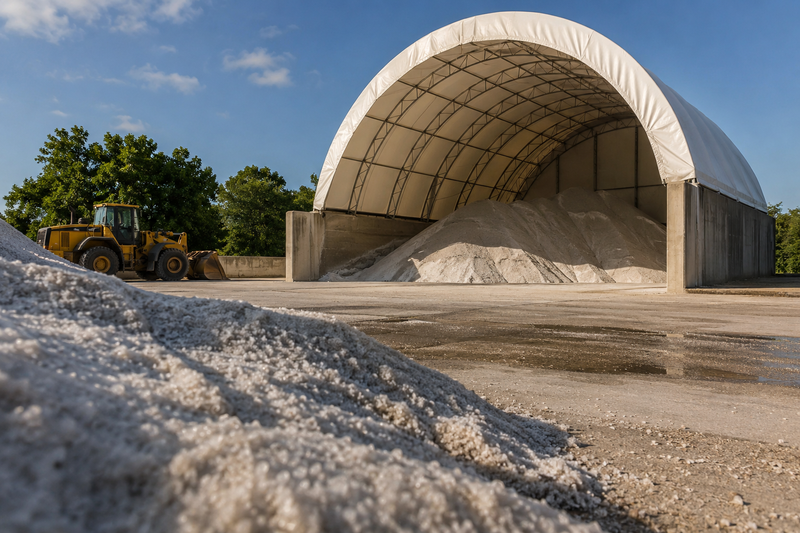
Here’s where the fiscal calendar actually works against you. Most Connecticut towns don’t formally solicit winter salt and sand bids until September — after budgets are locked, after the fiscal year has already started, and right as every other town in the region is issuing the same RFP into the same tightening supply pool at the same time. If your town’s storage capacity is modest — plenty of municipal contracts we’ve reviewed cap out around 1,000 to 1,500 tons of on-site storage — you’re not buying a season’s worth up front anyway. You’re depending on staged deliveries through the winter, which means you’re depending on your supplier’s ability to actually deliver when trucking capacity and mine output are both stretched thin.
A low bid on paper means nothing if the vendor can’t guarantee the tonnage when a February storm hits and everyone else is calling too.
July, by contrast, is quiet. Mines are running normal production schedules. Trucking isn’t backed up behind storm response. Distributors like KDM Services are still working with predictable lead times instead of triage lists. That’s the window where you can actually negotiate a committed volume, not just a quoted price.
What to Actually Do With This Window
- Finalize your tonnage estimate now, using last winter’s actual usage, not a budget placeholder. You can’t lock in supply you haven’t sized.
- Ask for a written commitment on volume, not just a number on price. After what happened in Western New York, “we’ll do our best” is not a plan. Get delivery guarantees in writing before September, while suppliers still have room to commit.
- Diversify away from single-source dependency. The New York crisis happened because too many municipalities were leaning on one dominant supplier. A distributor with multiple product lines and supply relationships — granular, liquid, treated blends — gives you options if one channel tightens.
- If liquid deicing infrastructure has been on your list, July is your last comfortable install window. Storage tanks and spray systems need dry, mild conditions to go in cleanly, and once fall site work ramps up, that window closes fast.
- Revisit your storage math. If you’re capped on-site storage and relying on staged winter deliveries, that dependency is exactly what a tight supply season punishes first. A staged delivery agreement locked in July is worth more than a lower per-ton price locked in November.
The Bottom Line
Nobody wants to think about ice melt in the middle of July. That’s precisely why the towns and property managers who do are the ones who aren’t scrambling — or paying double — come January. The fiscal year just turned over. The number in your budget is only as good as the contract behind it.
KDM Services works directly with public works departments, commercial property managers, and snow contractors across Connecticut, New York, and Massachusetts on bulk granular and liquid deicing supply, storage tank and sprayer installation, and municipal ice control programs — built around committed volume, not just a quoted rate. If your winter contract isn’t locked in yet, now is the window to have that conversation, not September.


