
If you followed the last few weeks of coverage on this site, there’s a decent chance your winter salt contract is further along than it was in July. You’ve priced your tonnage, maybe locked a staged delivery schedule, maybe pushed a contractor’s quote back until they could confirm their own material source. That’s real progress, and it solves a real problem.
It does not solve the next one, which is quieter, less dramatic, and shows up right around now: where is that salt actually going to sit once the truck shows up, and what shape will it be in by the time you need it in January?
Salt Doesn’t Care That It’s Still Summer
Rock salt and calcium chloride are both hygroscopic — they pull moisture directly out of the air, not just from rain or snow contact. In Connecticut, late August is one of the muggiest stretches of the year. A pile of bulk salt sitting uncovered on an asphalt pad during a humid August or September week is already absorbing enough ambient moisture to start clumping before the first frost even shows up on the forecast.
Once that clumping starts, it compounds. Compacted salt doesn’t flow evenly through a spreader. Crews end up either over-applying to compensate for inconsistent output or under-treating sections of a lot because the hopper jammed halfway through a pass. Either way, you paid full price for material that isn’t performing at full capacity — which quietly erases some of the value of locking a good contract in the first place.
Calcium chloride products are worse in this respect, not better. They’re more aggressively hygroscopic than plain rock salt, which means bagged or palletized calcium chloride left in a garage corner or an uncovered loading dock over a humid month can go from free-flowing to solid before you’ve even opened the bag.
What Actually Protects the Product
None of this requires anything exotic. It requires doing it before the deliveries start, not after the first storm exposes the gap.
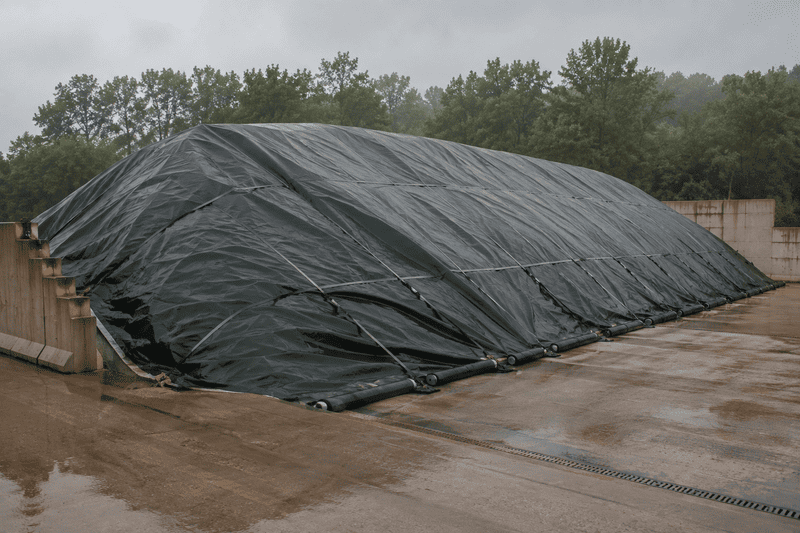
- Store bulk piles on a paved, sloped surface — asphalt or concrete, never bare ground — so water drains away instead of wicking up into the pile from below.
- Cover it completely, not loosely. A tarp that’s cinched down and inspected regularly does the job; a tarp thrown over the top and left alone through a windy September does not.
- If you’re storing inside a shed, dome, or barn structure, make sure it’s ventilated. Enclosed storage without airflow can trap condensation just as effectively as an open pile catches rain — the salt still absorbs the moisture, it’s just less obvious until you’re scooping it.
- Keep calcium chloride and other packaged products indoors, in a dry, temperature-stable space, not in an uninsulated shed where late-summer heat and humidity swing back and forth. Reseal any opened bags immediately, and work through inventory first-in, first-out so nothing sits open longer than it needs to.
- If you negotiated staged deliveries because your site doesn’t have season-long storage capacity, this matters even more, not less. The whole point of staged delivery is that less product sits on-site at once — but whatever is on-site between deliveries still needs to be protected, or the strategy that saved you money on the contract side quietly costs you on the performance side.
If Liquid Is Part of Your Program
If you added or expanded liquid deicing infrastructure this summer — tanks, totes, sprayer systems — late August is a good time to do a quick check rather than assuming everything installed correctly in June is still sound heading into fall. Confirm tank material is UV-stable if it’s sitting outdoors, check fittings and valves for any seasonal expansion or contraction issues, and make sure whatever concentrate is already staged hasn’t been sitting in direct summer sun longer than the product spec recommends.
Why This Is Worth Doing Now, Specifically
September is when bulk deliveries start ramping up for buyers who locked contracts over the summer. If your storage pad, tarping, or structure isn’t ready before those trucks arrive, you’re either scrambling to fix it with product already sitting exposed, or you’re accepting a delivery timeline that doesn’t match your actual readiness — which puts you right back in the position all of this summer’s planning was meant to avoid.
A properly stored pile of salt performs the same in February as it did the day it was delivered. An improperly stored one degrades a little more every humid week between now and the first storm. The difference isn’t dramatic on any single day. It’s dramatic by the time you’re relying on it during a January ice event and the spreader keeps jamming.
The Bottom Line
A locked contract answers “will I have enough salt.” It doesn’t answer “will that salt still work when I need it.” That second question gets decided by what happens on your site over the next several weeks, not by anything in the contract itself.
KDM Services supplies bulk granular and liquid deicing products, along with storage tanks and sprayer systems, to municipal, commercial, and contractor clients across Connecticut, New York, and Massachusetts. If you’re not confident your storage setup is ready for the deliveries you’ve already locked in, that’s worth a conversation before September, not after.


