
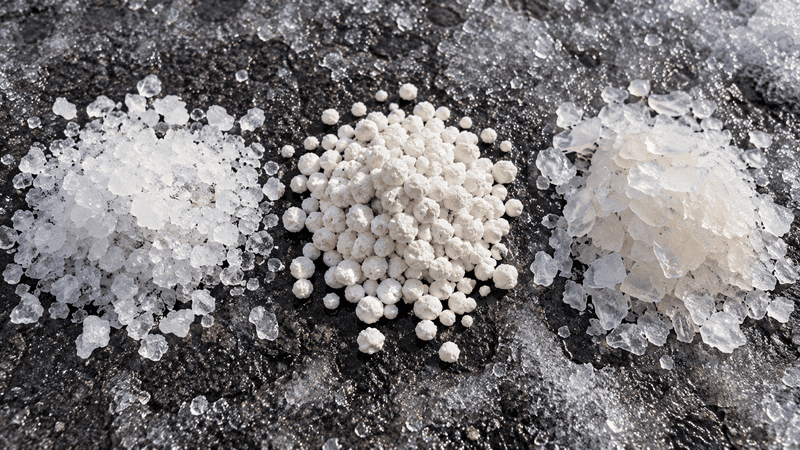
Walk down the ice melt aisle in October and every bag claims to be the strongest option on the shelf. The real differences come down to chemistry, and specifically to one number: the temperature at which each product stops being able to melt ice effectively.
Rock Salt (Sodium Chloride)
Rock salt is the cheapest option and the one most people default to, and for good reason — it works fine down to about 15–20°F. The problem is Connecticut regularly sees nights colder than that from December through February, and below that threshold, plain rock salt slows down dramatically or stops melting altogether. It’s also the hardest on concrete, metal, and vegetation of the three, since it relies on sheer volume to do its job.
Calcium Chloride
Calcium chloride generates heat as it dissolves, which is why it keeps working in much colder conditions — typically down to around -25°F. It also acts faster than rock salt because of that exothermic reaction. Products built around a calcium chloride base, like our IB Granular Ice Melt, are a strong choice for anyone who needs fast action during an active storm rather than waiting on a slower melt.
Magnesium Chloride
Magnesium chloride sits in between the two on raw cold-weather performance but is generally gentler on concrete, metal, and landscaping than either rock salt or calcium chloride, which is why it shows up often in pet-friendly and “safer for surfaces” formulations. It’s a reasonable trade: slightly less aggressive at extreme cold, noticeably easier on the surfaces underneath it.
Blended Products Split the Difference
Most of what you’ll find labeled as a “premium blend” is a mix of these ingredients, aiming to combine calcium and magnesium chloride’s cold-weather performance with a lower cost per bag than a pure calcium chloride product. Our Road Runner Ice Melt Premium Blend uses pelletized calcium chloride, magnesium chloride, and sodium chloride together and melts down to -15°F, which covers the vast majority of what a Connecticut winter throws at a driveway or parking lot. For facilities that need to push colder still, or want a highly visible application for quality control, Pro Powermelt is rated to -12°F with a bright green indicator color so crews can see exactly where it’s already been applied.
Picking the Right One
For most homeowners and light commercial use, a quality blended product covers every storm the region typically sees. If your property regularly deals with extreme cold snaps, shaded ice that lingers for days, or you’re managing a commercial or municipal contract where failure isn’t an option, it’s worth stepping up to a calcium-chloride-forward product rather than relying on straight rock salt and hoping the thermometer cooperates.


