
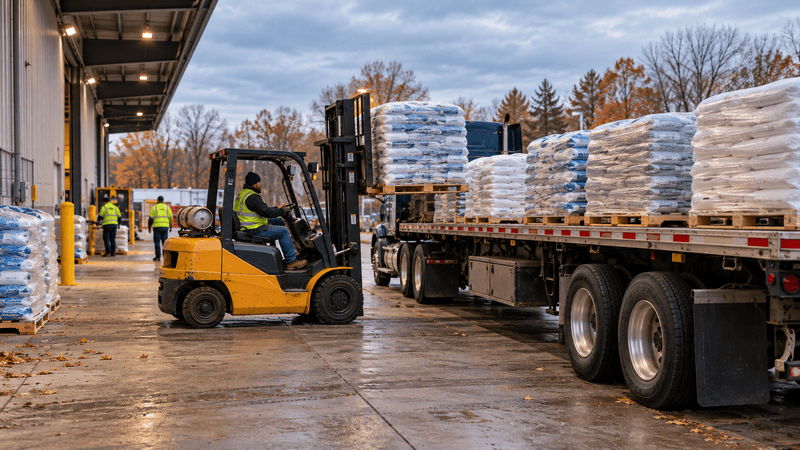
Late October is when most facilities managers, HOA boards, and public works departments finalize their winter materials order — early enough to lock in supply and pricing before the first real cold snap, but late enough to have a decent read on the season ahead. If you’re staring at a blank order form trying to figure out the right quantity, here’s a straightforward way to get to a number you can trust.
Start With Square Footage, Not Guesswork
Measure or pull from site plans the total paved area you’re responsible for — parking lots, drive lanes, sidewalks, and any entrances with an ADA obligation to stay clear. A reasonable planning figure for granular ice melt is one 49-bag pallet per 15,000–20,000 square feet for a property that gets a normal application schedule through a typical Connecticut winter. High-traffic entrances, north-facing areas that hold shade, and anywhere water tends to pool and refreeze should be budgeted at the higher end of that range, since they’ll need more frequent treatment than open, sun-exposed pavement.
Factor In Your Actual Storm History
Connecticut properties typically see somewhere between 10 and 20 icing events in a season, but that varies meaningfully by town and by how a given winter shapes up. If you track past-season usage — how many pallets you went through, how many emergency mid-storm orders you had to place — that history is a far better predictor than any generic formula. An emergency order mid-storm almost always costs more and takes longer to arrive than a pre-season order, so the goal is sizing your fall order to make that call unnecessary.
Consider Adding Liquid to the Mix
Many municipal and larger commercial accounts don’t rely on granular product alone. Pre-treating pavement or coating stockpiled salt with a liquid deicer before a storm reduces total material usage and gets ahead of the ice-to-pavement bond that makes plowing and scraping so labor-intensive. Our Municipal Ice Control page details how IB Deicing Liquid is used for stockpile treatment, on-board pre-wetting, and direct roadway pre-treatment, along with bulk delivery quantities from 1,000 to 4,500 gallons for public works yards.
Match the Product to the Job
Not every square foot of a property needs the same product. A lot of facilities use a heavier-duty option like Industrial Blue Ice Melt for parking lots and access roads, while reserving a gentler formulation for sidewalks and entrances closer to landscaping or pet-heavy common areas. Buying one product for the whole property is simpler on paper, but it’s rarely the most cost-effective approach once you account for where the real problem spots are.
When in Doubt, Order a Little Heavy
Running out mid-January means paying spot-market prices for whatever’s available, on whatever timeline a supplier can manage during their busiest stretch of the year. A slightly oversized fall order that carries a partial pallet into next season is a much smaller cost than an emergency call during a storm. If you want help translating your specific site into an actual quantity, contact KDM Services — we work through this math with commercial and municipal accounts across Connecticut every fall.


